IoT Solution Design Talk at AUC (Made In Egypt 2023)
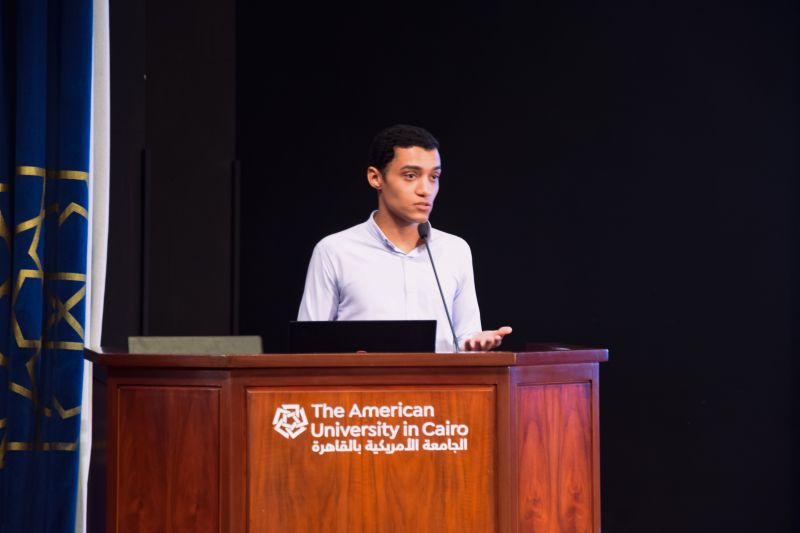
In August 2023, I gave an "IoT Solution Design" talk at The American University in Cairo as part of Made In Egypt 2023 (16th edition). The event brought together students, professionals, and founders, which made for a room where questions ranged from "what microcontroller should I start with" to "how do we scale from 10 devices to 10,000."
Why I focused on solution design, not hardware
Most IoT talks I have attended focus on the device layer: which board to use, how to wire sensors, how to read data. That is important, but it is only one piece of the puzzle. The projects that fail in IoT usually fail at the system level, not the device level. They fail because nobody thought about how the device talks to the cloud, how the cloud processes the data, or how the user actually interacts with the output.
I structured the talk around the full device-to-value chain:
- Device layer: Sensors, microcontrollers, and firmware. What data are you collecting, and how do you ensure it is reliable?
- Communication layer: How does data move from the device to the cloud? MQTT, HTTP, WebSocket, cellular? Each choice has trade-offs in power consumption, latency, and reliability.
- Cloud layer: Where does the data land, and what happens to it? Storage, processing, alerting, and integration with existing business systems.
- Application layer: How does a human actually use this data to make a decision or take an action?
Designing for reliability, not demos
One point I emphasized heavily: demo-quality and production-quality are fundamentally different in IoT. A demo can drop 5% of sensor readings and nobody notices. A production system that drops 5% of readings might miss a critical temperature spike in an industrial process.
I walked through real examples from my work at SudoTechs, where I built firmware for 20+ industrial IoT devices. The patterns that mattered most:
- Retry and buffering: When the network drops, the device should buffer readings locally and send them when connectivity returns. Losing data is not acceptable.
- Watchdog timers: Firmware crashes happen. A watchdog timer ensures the device resets and recovers automatically instead of going silent forever.
- OTA updates: You cannot physically access every device to flash new firmware. Over-the-air update capability is not a nice-to-have, it is a requirement for any production deployment.
- Telemetry validation: Sensors lie. A DHT22 occasionally returns -999 or 999. Your firmware should validate readings before transmitting them, not push garbage to the cloud and let the backend deal with it.
Connecting technical decisions to business value
The last section of the talk focused on something engineers often skip: why does any of this matter to the business? I have seen IoT projects that were technically impressive but delivered zero value because nobody connected the sensor data to an actual business decision.
For example, monitoring temperature in a warehouse is technically interesting. But the business value only exists if:
- Someone gets alerted when the temperature exceeds a threshold.
- The alert is actionable (they know which zone, which product, and what to do).
- The response happens fast enough to prevent damage.
If your IoT solution does not close this loop, you have built a science experiment, not a product.
The room and the conversations
What made the event genuinely valuable was the mix of people. Students asked foundational questions that forced me to explain things clearly. Professionals challenged assumptions and shared their own field experiences. Founders wanted to understand feasibility and cost.
A few conversations after the talk stuck with me. One student asked about choosing between ESP32 and STM32 for a startup prototype. My answer: ESP32 if WiFi is your primary communication path and you want fast iteration. STM32 if you need lower power consumption, industrial-grade reliability, or have specific peripheral requirements. Both are good choices, but the decision depends on your product constraints, not on which board is "better."
The takeaway I keep coming back to
Community knowledge-sharing is not charity. It is an investment. Every time I explain a concept to someone, I understand it better myself. And every strong engineer who enters the IoT space makes the ecosystem more capable, which creates better opportunities for everyone.
I plan to continue doing talks like this whenever the opportunity comes up. Teaching and building reinforce each other in ways that pure heads-down engineering cannot match.
Continue reading
Related engineering notes
Mar 8, 2026
REST vs WebSockets vs MQTT: Choosing the Right Protocol for IoT Projects
A practical decision framework for selecting communication protocols in IoT systems, based on real project trade-offs across latency, reliability, and infrastructure complexity.
Feb 10, 2026
Engineering Lessons from Data and IoT Product Work
Three practical patterns I keep applying across analytics systems, cloud workflows, and embedded integrations.
May 14, 2024
Design Patterns in Embedded Development: A Practical Approach
A practical embedded-systems write-up on why design patterns matter for maintainability, testability, and safer feature growth.